Best Graphics Cards for Gaming in 2026: Complete Buyer’s Guide
Struggling with low FPS, stuttering frame times, or a GPU that can’t keep up with your CPU? Picking the best graphics card for gaming in 2026 comes down to matching your resolution, budget, and workload to the right chip not just chasing the highest number on the box. This guide covers the top 10 GPUs actually worth buying right now, real current pricing, and how to avoid the most expensive mistake gamers make: pairing a powerful GPU with a CPU that holds it back. Want to compare these cards with the one in your PC? First check what graphics card you have.
Table of ContentsShow or hide all 7 sectionsShowHide
What Makes a Great Gaming Graphics Card in 2026
Before comparing specific models, here’s what actually determines real-world performance:
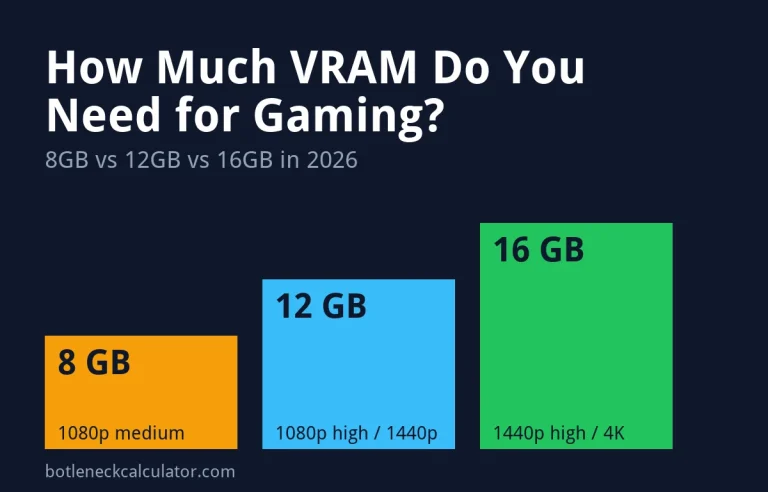
- VRAM (Video Memory): 8GB is now the bare minimum for 1080p; 12–16GB is recommended for 1440p and 4K to avoid texture stuttering in modern titles.
- Ray tracing and AI upscaling: DLSS 4 (NVIDIA) and FSR 4 (AMD) generate extra frames using AI, letting weaker cards hit playable frame rates at higher settings.
- Power draw (TDP): Higher-end cards can pull 350–450W check your power supply before buying.
- CPU-GPU balance: An expensive GPU paired with a weak or outdated CPU creates a bottleneck, where your processor can’t feed the graphics card fast enough wasting the GPU’s actual potential.
Quick Comparison: Best Graphics Cards for Gaming in 2026
| Graphics Card | Best For | VRAM | Approx. Price |
|---|---|---|---|
| NVIDIA RTX 5090 | 4K/8K, ray tracing, content creation | 32GB GDDR7 | $2,000–$3,000 |
| NVIDIA RTX 5080 | High-end 4K gaming | 16GB GDDR7 | $1,000–$1,290 |
| NVIDIA RTX 5070 Ti | Best 1440p performance | 16GB GDDR7 | $900–$950 |
| AMD RX 9070 XT | Best value vs. RTX 5070 Ti | 16GB GDDR6 | $650–$720 |
| NVIDIA RTX 5070 | Balanced 1440p pick | 12GB GDDR7 | $550–$600 |
| AMD RX 9070 | Strong mid-range alternative | 16GB GDDR6 | $600–$650 |
| NVIDIA RTX 5060 Ti (16GB) | Best 1080p/1440p value | 16GB GDDR6 | $550–$570 |
| AMD RX 9060 XT (16GB) | Budget 1440p option | 16GB GDDR6 | $430–$470 |
| NVIDIA RTX 5060 | Reliable 1080p pick | 8GB GDDR6 | $350–$360 |
| Intel Arc B580 | Best budget entry point | 12GB GDDR6 | $290–$310 |
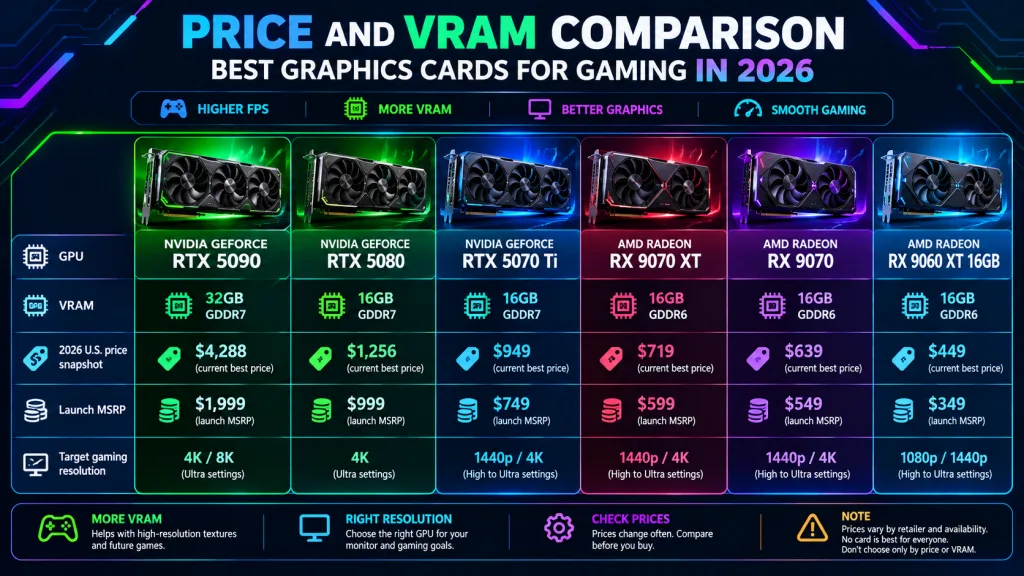
Prices fluctuate based on region and retailer stock treat these as current market ranges, not fixed MSRP.
Top 10 Best Graphics Cards for Gaming in 2026
1. NVIDIA GeForce RTX 5090 Best Overall (No Compromise)
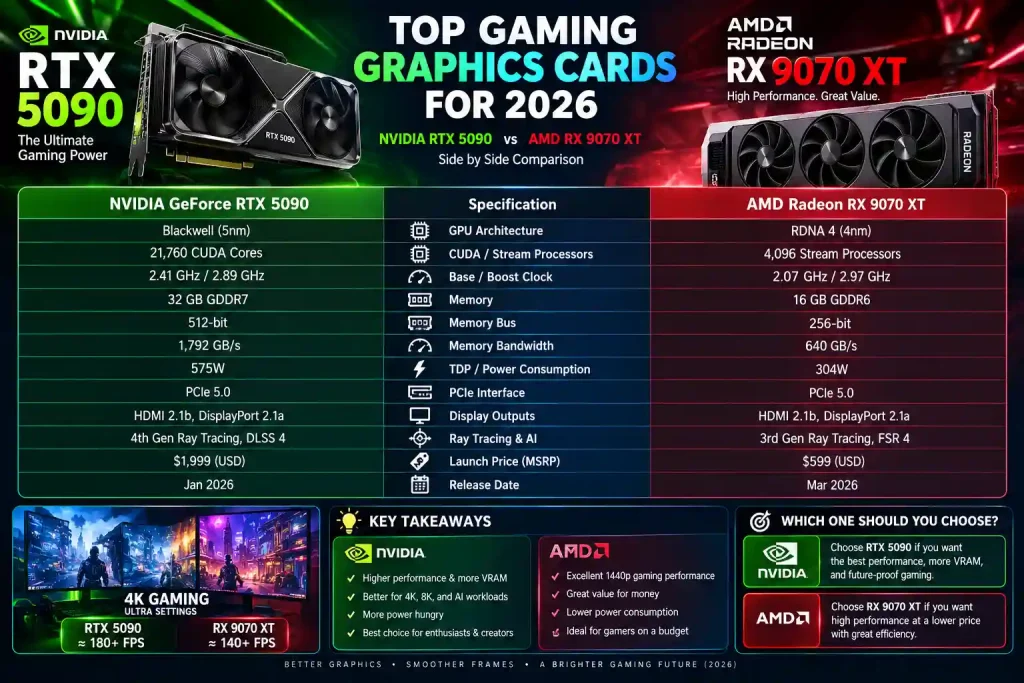
The RTX 5090 remains the fastest consumer GPU available, with 32GB of GDDR7 VRAM and class-leading ray tracing performance. It’s overkill for 1080p or 1440p, but for 4K gaming, streaming, and hybrid gaming/content-creation rigs, nothing else comes close. Best for: Enthusiasts and creators who want zero compromise at 4K.
Reasons to Buy:
- Fastest consumer GPU on the market, no close competitor
- 32GB VRAM handles 4K/8K and heavy content creation workloads
- Best-in-class ray tracing and DLSS 4 performance
Reasons to Avoid:
- Extremely expensive relative to actual gaming needs
- High power draw requires a 1000W+ PSU
- Massive overkill for 1080p/1440p gaming
2. NVIDIA GeForce RTX 5080 Best High-End 4K Card
With 16GB of GDDR7 VRAM and strong DLSS 4 support, the RTX 5080 delivers excellent 4K performance at roughly half the price of the 5090. It’s the practical high-end choice for most serious gamers. Best for: Gamers who want near-flagship 4K performance without flagship pricing.
Reasons to Buy:
- Strong 4K performance at a more reasonable price than the 5090
- Excellent DLSS 4 and ray tracing support
- Good VRAM headroom for future titles
Reasons to Avoid:
- Still a significant investment for most budgets
- Requires a capable CPU to avoid bottlenecking at 1440p
- Diminishing returns if your monitor tops out at 1440p
3. NVIDIA GeForce RTX 5070 Ti Best 1440p Performance
16GB of fast GDDR7 VRAM and strong ray tracing make this the go-to card for high-refresh 1440p gaming. It also handles light 4K well with DLSS enabled. Best for: 1440p gamers who don’t want to compromise on ray tracing.
Reasons to Buy:
- Excellent 1440p performance with headroom for high refresh rates
- 16GB VRAM keeps it relevant for years
- Strong ray tracing without flagship pricing
Reasons to Avoid:
- Expensive compared to the similarly performing RX 9070 XT
- Not ideal as a primary 4K card for demanding titles
- Price fluctuates significantly by region
4. AMD Radeon RX 9070 XT Best Value Alternative
AMD’s most competitive card in years it undercuts the RTX 5070 Ti by roughly $200–250 while staying close in raw performance, now with FSR 4 closing the upscaling gap. The main catch: it draws more power, so plan for at least an 850W PSU. Best for: 1440p gamers who want NVIDIA-rivaling performance at a lower price.
Reasons to Buy:
- Significantly cheaper than the RTX 5070 Ti with comparable performance
- Full 16GB VRAM for future-proofing
- FSR 4 has closed much of the upscaling gap with DLSS
Reasons to Avoid:
- Draws more power than its NVIDIA equivalent
- No multi-frame generation tech like NVIDIA’s MFG
- Stock availability can be inconsistent at MSRP
5. NVIDIA GeForce RTX 5070 Best Balanced Pick
A well-rounded 12GB card that handles 1440p comfortably and 1080p with headroom to spare. DLSS 4 support extends its lifespan further into future titles. Best for: Gamers upgrading from a previous-gen mid-range card.
Reasons to Buy:
- Well-balanced price-to-performance ratio
- DLSS 4 support extends its useful lifespan
- Handles 1440p comfortably for most titles
Reasons to Avoid:
- 12GB VRAM is good, not exceptional, at this price point
- Outpaced by RX 9070 XT in some raw performance benchmarks
- Not a strong 4K option
6. AMD Radeon RX 9070 Strong Mid-Range Alternative
Sitting just below the 9070 XT, this card offers 16GB VRAM and solid 1440p performance at a more accessible price, making it a strong AMD pick for gamers who don’t need the top tier. Best for: Value-focused 1440p gamers wanting more VRAM than NVIDIA’s equivalent tier.
Reasons to Buy:
- More VRAM than the NVIDIA RTX 5070 at a similar price
- Solid 1440p performance for the cost
- Good FSR 4 support
Reasons to Avoid:
- Slightly behind the 9070 XT in raw performance
- Ray tracing still trails NVIDIA’s equivalent tier
- Power efficiency lags behind NVIDIA cards
7. NVIDIA GeForce RTX 5060 Ti (16GB) Best 1080p/1440p Value
The 16GB variant is the smarter buy over the 8GB model the extra VRAM future-proofs it against increasingly demanding game textures, while still hitting strong 1080p and 1440p frame rates. Best for: Budget-conscious gamers who still want room to grow.
Reasons to Buy:
- 16GB VRAM at a genuinely accessible price
- Strong 1080p and solid 1440p performance
- DLSS 4 support included
Reasons to Avoid:
- Not built for consistent 4K gaming
- 8GB variant of the same card is a trap avoid it
- Mid-tier core count limits high-refresh 1440p in demanding titles
8. AMD Radeon RX 9060 XT (16GB) Best Budget 1440p Card
16GB of VRAM at a genuinely budget price point makes this one of the best value cards on the market for 1440p gaming with FSR upscaling. Best for: Gamers who want 1440p capability without spending $500+.
Reasons to Buy:
- Excellent VRAM-to-price ratio
- Capable 1440p performance with FSR upscaling
- One of the best value cards on the market right now
Reasons to Avoid:
- Ray tracing performance is modest
- Not suited for 4K gaming
- Slightly higher power draw than NVIDIA equivalents
9. NVIDIA GeForce RTX 5060 Best Reliable 1080p Card
A dependable, efficient card for 1080p gaming with DLSS 4 support, though its 8GB VRAM is a limiting factor in newer, texture-heavy titles. Best for: Entry-level builds focused purely on 1080p.
Reasons to Buy:
- Efficient and reliable for 1080p gaming
- DLSS 4 support helps extend performance
- Affordable entry point into the RTX 50-series
Reasons to Avoid:
- 8GB VRAM is increasingly limiting in newer titles
- Not suitable for 1440p at max settings
- Less future-proof than the 16GB alternatives
10. Intel Arc B580 Best Budget Entry Point
With 12GB of VRAM at around $300, the Arc B580 punches above its price class for 1080p and light 1440p gaming. Intel’s driver support has matured significantly, making this a genuinely safe budget pick in 2026. Best for: First-time builders and budget gamers who want more VRAM than NVIDIA or AMD offer at the same price.
Reasons to Buy:
- More VRAM than competitors at the same price point
- Genuinely strong value for 1080p and light 1440p
- Driver stability has matured significantly since launch
Reasons to Avoid:
- Raw performance still trails NVIDIA/AMD at similar price
- Ray tracing capability is limited
- Driver ecosystem, while improved, is still newer than established brands
Best Graphics Card by Use Case
Best for 4K Gaming: RTX 5090 or RTX 5080 Best for 1440p Gaming: RTX 5070 Ti or RX 9070 XT Best for 1080p Competitive/Esports: RTX 5060 or RX 9060 XT Best for Streaming + Gaming Together: RTX 5070 Ti or RX 9070 (extra VRAM headroom for OBS/encoding) Best for Content Creation + Gaming Hybrid Use: RTX 5090 or RTX 5080 (CUDA acceleration for rendering) Best Budget Pick Overall: Intel Arc B580
Common GPU Buying Mistakes to Avoid
- Ignoring CPU-GPU balance an RTX 5080 paired with an old quad-core CPU will bottleneck badly, wasting money on GPU power you can’t use. Before buying, it’s worth checking your exact CPU and GPU pairing with a free bottleneck calculator to see where the limit actually sits.
- Skipping VRAM for a higher clock speed 8GB cards are already struggling in some 2026 titles at max settings; more VRAM often matters more than raw clock speed.
- Underestimating power supply needs high-end cards can draw 350–450W; an underpowered PSU causes crashes, not just lower performance.
- Buying based on MSRP instead of real street price GPU pricing shifts weekly; always check current retailer prices before assuming a card is a “good deal.”
- Overspending on a tier you don’t need a 1080p gamer doesn’t need a $1,000+ GPU; match the card to your actual monitor’s resolution and refresh rate.
Sources: NVIDIA – RTX 5090 specifications; NVIDIA – RTX 5080 specifications; AMD – Radeon RX 9070 XT specifications; TechSpot – RTX 5070 Ti vs RX 9070 XT (52 games); TechSpot – RTX 5090 review.
Frequently Asked Questions
What is the best graphics card for gaming in 2026?
The NVIDIA RTX 5090 is the best overall for pure performance, but the RTX 5070 Ti and AMD RX 9070 XT offer the best balance of price and performance for most gamers.
Is AMD or NVIDIA better for gaming in 2026?
NVIDIA generally leads in ray tracing and AI upscaling (DLSS 4), while AMD’s RX 9000 series offers stronger value and more VRAM per dollar with FSR 4 closing much of the upscaling gap.
How much VRAM do I need for gaming in 2026?
8GB is the minimum for 1080p, but 12–16GB is strongly recommended for 1440p and 4K to avoid stuttering in newer, texture-heavy games.
How do I know if my CPU is bottlenecking my graphics card?
Check your specific CPU and GPU combination against an online bottleneck calculator if your CPU can’t feed data fast enough, your GPU will sit underutilized regardless of how powerful it is.
Do I need a high-end graphics card for esports games?
No competitive titles like Valorant or CS2 run well even on mid-range cards like the RTX 5060 or RX 9060 XT, especially at 1080p.
Is it worth buying a graphics card for both gaming and content creation?
Yes, particularly the RTX 50-series NVIDIA’s CUDA cores accelerate video editing and 3D rendering software significantly better than AMD’s equivalents.
How much power supply do I need for a high-end GPU?
NVIDIA lists 850W of system power for the RTX 5080 and AMD lists a 750W minimum PSU for the RX 9070 XT, while the RTX 5090 needs 1000W according to NVIDIA.
Should I wait for next-gen GPUs instead of buying now?
If your current card meets your needs, waiting rarely hurts but if you’re bottlenecked today, the performance you lose waiting often outweighs future price drops.
Are budget graphics cards like the Intel Arc B580 reliable in 2026?
Yes Intel’s driver stability has improved substantially since launch, making the Arc B580 a genuinely safe budget recommendation now, not just a “value on paper” option.
What’s the difference between RTX 5070 and RTX 5070 Ti?
The Ti variant has more VRAM (16GB vs. 12GB) and more CUDA/RT cores, making it noticeably better for 1440p and light 4K, at a higher price point.
Final Thoughts
The best graphics card for you depends on your monitor’s resolution, your budget, and just as importantly the rest of your system. A flagship GPU paired with a bottlenecked CPU won’t deliver the performance you’re paying for, so before finalizing your purchase, double-check your CPU and GPU pairing is actually balanced for your target resolution and refresh rate.